
Start with the reason you are going
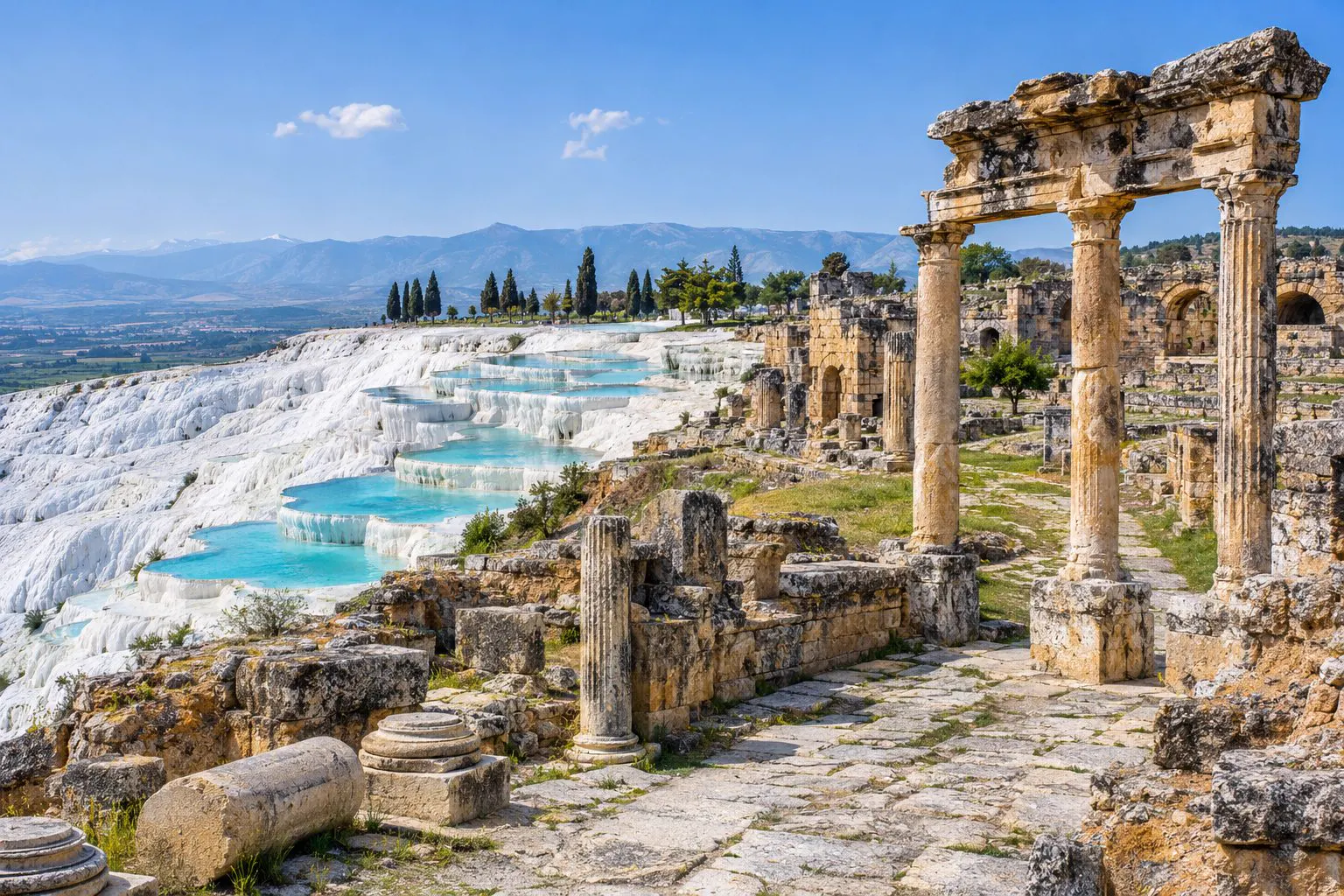
Seeing Pamukkale and Laodicea in one day can work if you are already in the Denizli area, know which parts of each site you want to see, and have transport arranged. It becomes harder when your day starts and ends with flights or a long drive. Pamukkale is more than a single stop for a photograph: the white travertine terraces sit beside Hierapolis, the ancient city that forms part of the same UNESCO World Heritage property. Laodicea is a separate archaeological site with its own walking route. Before asking for both in a tour, decide whether you want to compare two ancient cities, spend more time at the terraces, or follow a specific interest such as Roman urban design or early Christianity.
What the two sites let you compare
At Hierapolis the terraces and the ruins belong to the same visit, so you can move from the mineral landscape to a theatre or a stretch of ancient street and ask how a spa city grew beside its springs. Laodicea offers a different scale of visit. Go Türkiye identifies monumental streets, theatres, public buildings and churches at the site. If you find street plans more interesting than a succession of individual monuments, ask your guide to choose one route through Laodicea and explain where it takes you. Pause at a junction, see what would have been in view and ask what a person arriving from outside the city would have encountered first. That is one way to make two archaeological visits feel genuinely different.
Give Hierapolis its own place in the schedule
If the terraces are your main reason for coming, set a time for them and choose one manageable walk through Hierapolis before scheduling your second stop. The theatre and the northern necropolis are both listed in the official tourism route, but you do not have to put both on a day with another excavation. Ask which area works with your entrance and exit, and whether your vehicle can meet you where the walk finishes. Allow time for the transition between the ruins and the travertines, including putting shoes back on if you use a section where footwear is restricted. If there is a separate activity you are counting on, such as visiting the museum, verify access and admission before treating it as a fixed part of the day.
Plan Laodicea around one interest
Laodicea is worth choosing when your group can name what it wants to see there. For a history-focused visit, a main street and nearby civic buildings can give you a sense of the scale without asking everyone to walk across the entire site. For a faith-focused visit, ask whether the church is accessible on your date and what the guide will cover around it. Go Türkiye includes Laodicea among the Seven Churches of Revelation, which can give that stop a clear purpose. If you are more interested in photography, pick a stretch with sightlines you can explore slowly. Use the same meeting point for the whole party, and agree on a latest departure time before you enter.
Two schedules to discuss with your guide
With a full day based in or near Denizli, one sensible sequence is to visit Pamukkale and a selected part of Hierapolis first, pause for lunch, then take a shorter guided walk at Laodicea. The second option suits travellers for whom the church or city plan is the main draw: start at Laodicea, then keep a fixed afternoon window for Pamukkale and choose a short Hierapolis route that works with it. These are proposed sequences rather than suggested opening hours. The order you choose should take account of the actual meeting time, entrance arrangements, and any fixed transport at the end of the day. Put the sites and the lunch stop on the same written itinerary so everyone can see where a delay would cut into the visit.
Allow for the walk as well as the drive
A map shows that the sites are in the same area. It cannot tell you how long you will stand at the entrance, whether your group will want a break or what the surfaces will feel like underfoot. Ask for a description of stairs, slopes, loose stone and stretches of exposed path. If someone in the group prefers to limit walking, ask whether they can join an abbreviated route and where they can comfortably meet the others. Bring water and protection for the conditions on the day. Give yourself time to change footwear if the terrace visit calls for it. A route works better when the guide knows in advance what distance or terrain would make the afternoon uncomfortable.
Be realistic about the return journey
If you start in Istanbul, take the arrival time at the first attraction and work backwards through the collection, baggage and airport transfer. On the return leg, use the time you need to reach the terminal to decide when you must leave the last site. With a fixed flight or onward connection, identify one part of the plan you can drop comfortably. If both archaeological visits matter to you, consider spending a night nearby before continuing your tour. If you are driving from another destination, ask where the day ends and whether luggage will be carried or collected at the hotel. A stop is only worthwhile if you have time to get out, walk, and understand what you are seeing.
Before requesting a private route
Ask for a written proposal that names the sites, identifies which gate you expect to use where relevant, and includes the planned collection and drop-off points. Check whether tickets, guiding and the transfer between the two sites are included. Ask explicitly about Laodicea when discussing a Pamukkale and Hierapolis tour, since the two names on that itinerary do not establish an additional stop. Put your strongest preference first and explain which alternative you would choose if conditions or timing change. For a group that values photographs and archaeology equally, a useful compromise is to keep a clear block for the terraces and ask for a focused walk at each city. That makes it easier to compare offers by the time you will actually spend on the ground.